
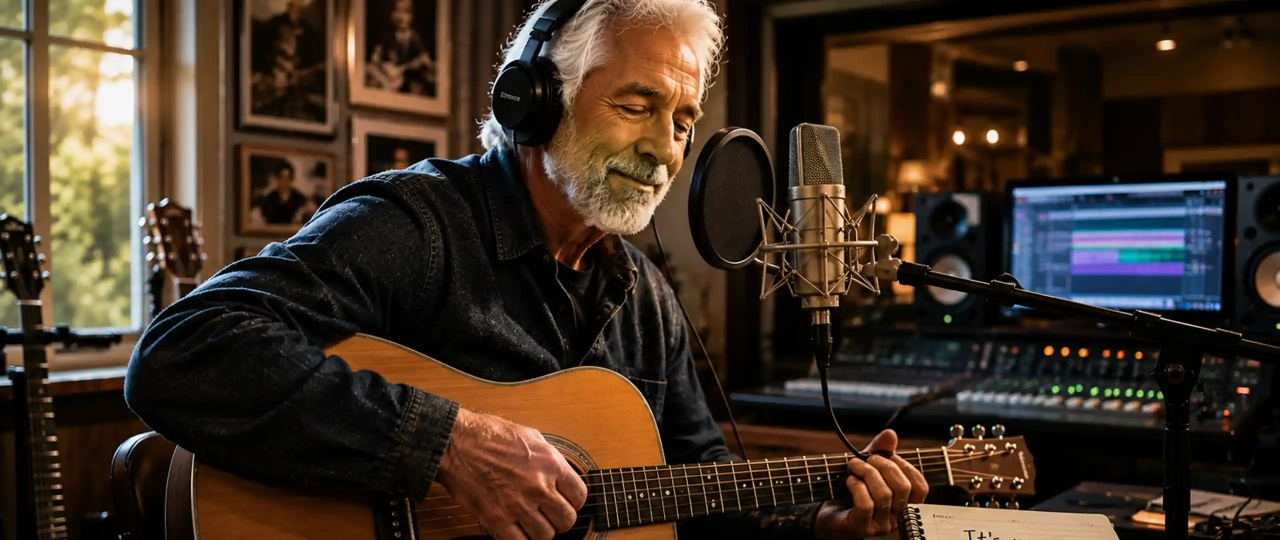
There is a question I have heard many times over the years: "Do you think I'm too old to record a song?" My answer is almost always the same: No. You're never too old.
In fact, I believe there can be something particularly special about recording a song later in life. By then, you have lived a little. You have stories to tell, memories to share and experiences that can give meaning to the words you sing.
You may not have the voice you had at twenty, but you have something you didn't have then — a lifetime of experience.
The Dream We Put Aside
Many people have a musical dream when they are young. Perhaps you played guitar at school, sang in a local group, wrote songs in a notebook or learned a few chords on the piano. Then life happened.
Work, marriage, children and other responsibilities took priority. Music was gradually pushed into the background, and the years passed. One day you realise that the song you always wanted to record is still sitting in your head. Maybe you think the opportunity has gone. It hasn't.
Work, marriage, children and other responsibilities took priority. Music was gradually pushed into the background, and the years passed. One day you realise that the song you always wanted to record is still sitting in your head. Maybe you think the opportunity has gone. It hasn't.
You Don't Have to Become a Professional
Recording your first song doesn't mean you have to become a professional musician. You don't need a record deal, thousands of followers or even the desire to perform in public.
You might simply want to record a song for yourself, your family or your friends. Perhaps you have written a song about someone you love. Maybe there is a song that reminds you of home, or you've always wanted to record an Irish ballad, a country song or something you wrote yourself.
Whatever the reason, it is enough. A recording can become something you keep for the rest of your life. One day, your children or grandchildren may listen to it and hear your voice long after you are gone. That makes it much more than just a recording.
Your Voice Has Something to Say
One of the biggest concerns people have about recording later in life is their voice. They may think it isn't good enough.
But a recording doesn't have to sound like a young person's voice to be good. Some voices become more interesting with age. They develop character, warmth and emotion.
When you sing a song you genuinely understand, the listener can hear that experience in your voice.
A younger singer might sing the words beautifully. Someone who has lived through the story may feel every word. That can be very powerful.
Technology Can Help
Modern recording technology has made it much easier to create a high-quality recording. You no longer need to travel to a huge commercial studio with a large band and expensive equipment.
A singer-songwriter can record vocals, guitar, piano or other instruments and build a complete production around them.
The arrangement can be simple or elaborate, depending on what the song needs. The important thing is not to hide the person behind the recording. The technology should serve the song — not the other way around.
You Don't Have to Be Perfect
Another thing that stops people recording is the fear of making mistakes. They worry about singing the wrong note, forgetting a word or not playing an instrument perfectly.
But recording isn't a live performance. We can record several takes, work on difficult sections and improve the arrangement, vocal sound, balance and overall production.
What matters most is capturing the character and emotion of the performance. I've heard technically perfect recordings that left me cold. I've also heard imperfect performances that moved me deeply. Feeling matters.
Your Story Is Worth Recording
Perhaps the most important thing I would say is: Don't underestimate the value of your own story. You have lived through things that nobody else has experienced in exactly the same way.
You remember people, places, relationships, difficult times, happy occasions and moments that shaped your life. A song can capture some of those memories. It can tell a story that might otherwise disappear.
Imagine sitting down years from now and hearing your own voice singing something you wrote decades earlier. That is a wonderful thing.
It's About Leaving Something Behind
We often think of recording as something professional musicians do. But recording can also be about preserving memories. It might be a father recording a song for his children, a grandmother singing an old Irish ballad, a retired musician returning to an instrument he hasn't played for years, or a songwriter finally recording the songs that have been sitting in a drawer. There is no age limit on that.
Take the First Step
You don't need a perfect voice or a perfect song. You don't even need to know exactly how the finished recording should sound. You simply need an idea and the willingness to take the first step.
After more than four decades in music, I still believe that one of the most exciting moments is hearing an idea become real. A person walks into a studio with a song in their head. Later, they walk out with a recording.
And sometimes that recording becomes something they treasure for years. So if you've been thinking about recording your first song but keep telling yourself that you're too old, I'd encourage you to think again. You're not too old.
You may simply be at the age when you finally have something worth saying. And perhaps your first song is still waiting to be heard.