
As far back as I can remember, I have loved music. It is 1951. I am five years old, growing up in a small country cottage outside Mullingar. We had an old wireless, with my mother having it switched on for much of the day.
I found empty bottles, put different amounts of water into them and tapped them with a stick. Each produced a different note and, to me, they created a melody. Perhaps that was my first musical instrument.
Saturday night was bath night, in a large aluminium bath in front of the open fire. Afterwards came the important part: Jimmy Shand and his band from Scotland playing jigs, reels and hornpipes on the wireless. The next day I would be humming the tunes and trying to reproduce them with my bottles.
Eventually, my mother bought me an accordion. I was suffering with asthma, and playing helped my breathing as well as giving me endless enjoyment.
As I got older, I became fascinated by the guitar and The Shadows. When some local musicians and I formed a group, I wanted to call us The Young Shadows. The name was already taken, so we became The Young Outlaws instead. Before long I was playing lead guitar with several local groups.
The Irish Music Scene of the 1960s
Ireland in the 1960s was very different from today. For many people, especially in rural Ireland, live music and dancing were a major part of social life.
I remember travelling from Mullingar to places such as Achill Island, Limerick, Galway and Wexford. I played with Andy Hennessy Showband, the Dinny Hughes Showband and later The Countrymen Showband from Clara.
We might leave around midday for a dance that night, travelling 150 miles or more in an old Volkswagen van, with six or seven musicians sitting in the back, often perched on amplifiers.
We would arrive at an old dance hall with wooden seats, bare bulbs and little or no heating. But none of that mattered once the music started.
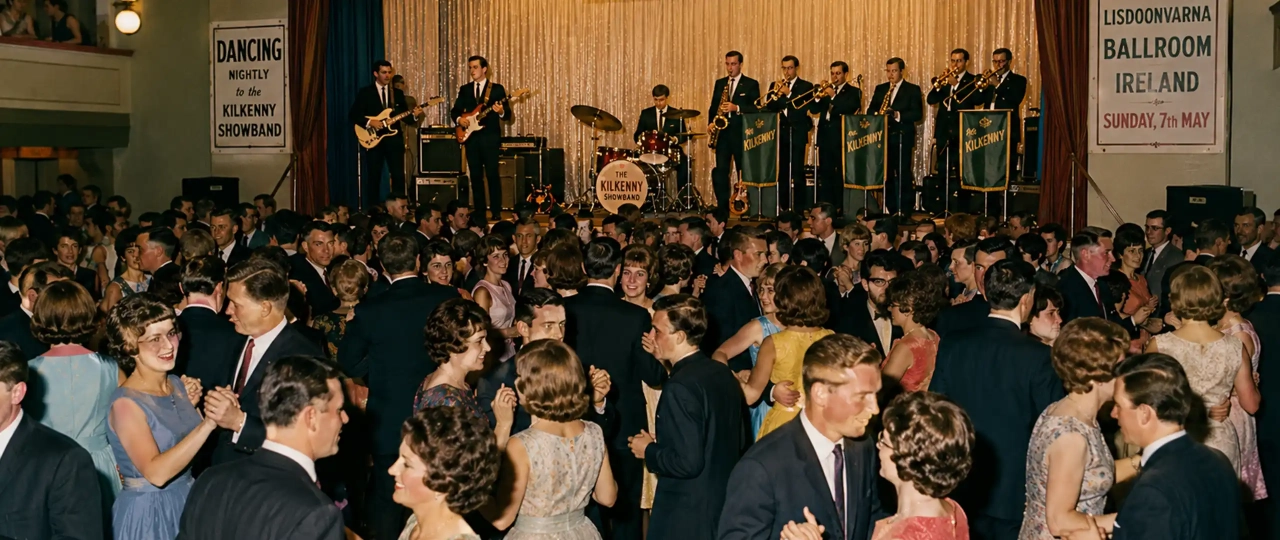
Dances could run from nine at night until two in the morning or later. One strong memory is how different social life was then. The boys and girls often sat on opposite sides of the hall. When the band started, the boys would cross the floor, sometimes almost running, to ask the girl they had their eye on to dance.
The dance hall was where young people met, socialised and sometimes met the person they would eventually marry.
From Marquees to Big Bands
During the summer, promoters put up large marquees at country crossroads because there weren't enough halls for the growing crowds. The conditions could be basic: uneven floors, no heating, no proper toilets and poles through the dancing area.
Yet people came in their hundreds. The music was what mattered. As crowds grew, smaller groups evolved into larger bands with well-known singers and brass sections. The era of the Big Band had arrived.
Names such as Big Tom, Dickie Rock, Joe Dolan, Brendan Bowyer and Larry Cunningham became household names. RTÉ radio and television helped drive their success, while Release Records in Dublin was at the centre of the Irish record business.
Promoters began building large ballrooms capable of holding 800, 1,000 or more people. I was lucky enough to experience that world from stages all over Ireland, guitar in hand, watching the music scene change before my eyes.
The 1970s — The Ballad Boom
By the 1970s, the showband era was fading, but Irish music was changing rather than disappearing.
The Clancy Brothers and Tommy Makem, The Dubliners, Planxty and Clannad helped bring Irish folk and traditional music to new audiences.
I remember entering a pub singing competition in Kilbeggan and winning first prize for singing Johnny McEvoy's “Muirshin Durkin”. That experience reinforced something that has remained important to me: the power of a good song.
A great song doesn't need complicated production. If the melody is strong, the words mean something and the performance is honest, people will listen.
The 1980s and 1990s
By the 1980s, the ballroom and traditional showband era had largely faded, but Ireland still had a vibrant mixture of traditional, folk, country and rock music. Irish rock had reached an international audience through artists such as U2, The Boomtown Rats and Thin Lizzy.
By the 1990s, digital technology was transforming recording and opening possibilities that earlier generations could only dream about.
When I look back, however, it isn't the technology I remember most. It is the people: musicians arriving with their instruments, the sound of a band warming up, the excitement before a performance, the atmosphere of the old dance halls and the camaraderie between musicians.
Many had day jobs. I was working a 45-hour week with the ESB while playing perhaps three nights a week in a band. Many travelled long distances for modest money, but they loved music. And that love of music kept everything going.
From Dance Halls to Home Studios
Since the 1950s, we have gone from orchestras and showbands to folk groups, rock bands, digital recording, home studios, streaming and now artificial intelligence.
Yet one thing hasn't changed. People still love music. A singer still wants to hear a great song come to life. A guitarist still wants to play a beautiful part. A songwriter still wants somebody to connect with their words.
The equipment and industry have changed beyond recognition, but the reason we make music hasn't changed. We make music because it is meaningful, uplifting, and touches something in the soul of each one of us.